Prologue
Berlin, 1933.
The signs were everywhere, but in their vulnerability, the people of Germany chose to believe promises of safety and order. They were told that authorities would remove criminals and undesirable elements from the streets—that law and discipline would return, and that honest citizens would finally prosper again. For a moment, it felt true, at least until the laws started to change.
Quiet and precise edits to the legal code redefined who counted as a criminal. People who had done nothing wrong were suddenly labeled as enemies of the state. Quietly, the definitions shifted, and anyone who spoke too loudly, looked too long, or loved the wrong person was now potentially committing a crime. Neighbors disappeared in the night; they had done nothing wrong, but no longer fit the new definition of what was right.
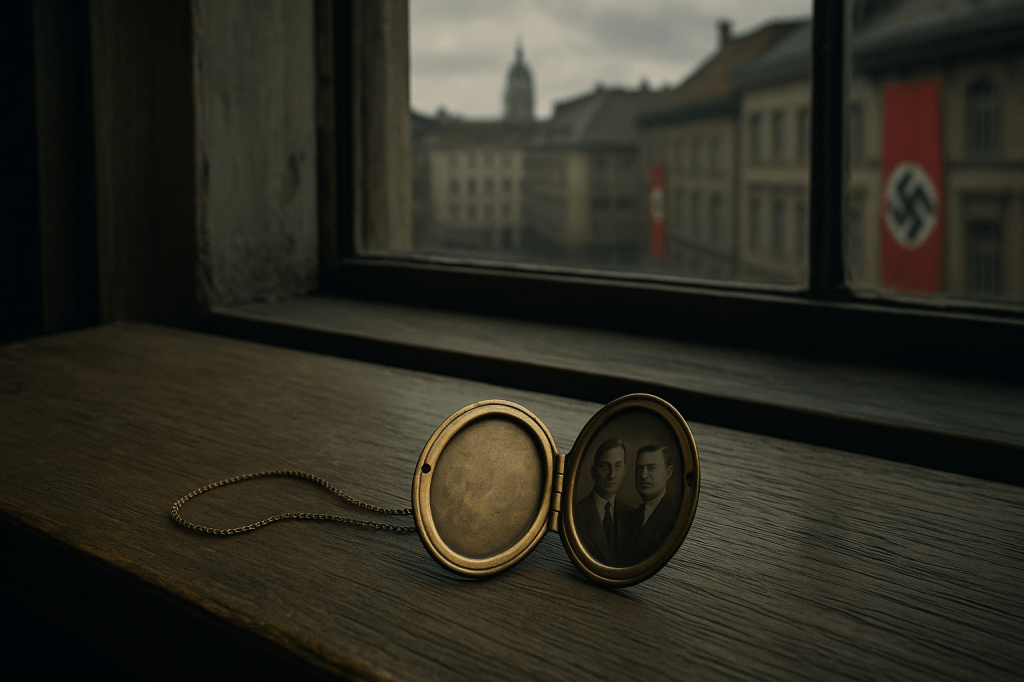
From my apartment window, I watched the sun rise over Schöneberg that morning, illuminating the violence of the previous night’s raids—broken glass catching the morning light outside the Jewish bakery just down the street from me. New posters were displayed over the brick wall, still wet with glue, promising a new dawn of prosperity while blaming homosexuals, Jews, and other minorities for the pain the country experienced. Each day, the call for a purified nation grew louder, and agreeing with it became a question of survival.
I kept a small locket, pressed against my chest, hidden from view. Inside was a photograph—two young men smiling at each other, unafraid, taken at a time when such affection was not scrutinized by the authorities. When the police trucks rattled down the avenue, I pressed myself into the shadows, my heart beating against the locket, against the forbidden love it protected. I knew what happened to men like me; the lucky ones ended up in camps, wearing coarse blue and gray striped uniforms with pink triangles stitched over their hearts; the rest were shot in the streets, like vermin.
I kept walking, knowing that beneath the city’s rubble of national pride and lies, unconditional love still lived in hidden places—fragile, hunted, but alive.
Part I – The Purge
At first, it may have been easy to believe the raids were just a reaction, but soon they became too frequent and too focused. You’d hear about someone vanishing—then it would happen again two streets over. Then again. A teacher was just gone one day. A shop closed without warning. The man who lived above me stopped opening his curtains, and no one asked why.
People stuck to safe words—weather talk, neighborly nods, praise for the Chancellor spoken just loud enough to be overheard. We learned not to say anything that mattered—just enough breath to pass through the day without notice.
The newspapers spoke of traitors removed from within, Röhm, Schleicher, and many SA leaders. Names printed in bold beside phrases like “cleansing” and “national renewal.” They called it a necessary correction — the purging of threats to order. But the message underneath was clearer than the ink: no one is untouchable.
I remembered hearing Röhm’s name whispered in corners of the city—always low, always careful. He wasn’t just a soldier or a party official. His private life mirrored mine in ways no one ever dared speak out loud, maybe that’s why they made an example of him. He climbed too high, trusted too long—and now he’s gone, and with it any hope for people like us under these new moral rules that kept piling up.
One morning, I found a paper slipped beneath my door. Not a notice. Not even a warning. Just a list. Paragraph 175 printed at the top in bold, and below it, language that felt more surgical than legal—phrases like unnatural acts, corrupting influence, and protecting youth. There were no names on the paper, but the weight of what it implied was enough. It didn’t need to accuse directly — only to suggest that someone was watching, and someone had been seen. I folded it carefully, but my hands wouldn’t stop shaking.
I never saw it coming, to be honest, not because the signs weren’t there – they were. Scribbled in chalk on the side of the butcher’s wall, shouted from loudspeakers at parades, slipped into the mouths of neighbours with a nervous laugh and a glance over the shoulder. But back then, I thought it couldn’t really reach me. I was careful and polite, always blending into the background. I had even learned to laugh at the right jokes, surely that had to count for something.
Part II – Between the Lines
I lived on the third floor of an old building just off Nollendorfstraße, where the windows rattled in winter and the street below never fully slept. My landlord, Fraü Engel, was a widower with a perpetually closed-off expression. She had a dog that hated everyone except me; for some reason, the dog liked me.
I worked at a bookstore—not a famous one, not the kind that secretly carried American novels, but a small shop that sold children’s books, church calendars, and memoirs about the Ottoman-German alliance that no one read anymore. It was modest, but honest work, I always enjoyed the quietude of a bookstore, it felt safe—at least, it used to be. Then, one morning, the display window changed; instead of fairy tales and hiking guides, the owner—a nervous man who smoked more than he spoke—filled it with government-printed pamphlets in sharp fonts, with words like “decency” and “cleansing” stamped over pictures of smiling Aryan families.
A new section appeared in the back, lined with red leather volumes I’d never seen before. I remained quiet, kept my head down, and dusted shelves already clean to discreetly take a closer look at these books. They were written by so-called doctors who claimed to know how to ‘correct’ those who didn’t fit the traditional sense of family.
I met Emil at the old tram depot that night—our usual place, tucked behind idle cars and a wall of dirty brick. He had a bottle of schnapps and a cigarette he claimed was French.
We sat on a cold slab of concrete at the end of the row, knees nearly touching. Now and then, our shoulders brushed—quiet, accidental—and neither of us said a word. Emil took a long drag, staring down the empty tracks. “Did you hear about Daniel?” he asked quietly, as if he wasn’t sure he should even mention it.
I nodded steadily, though I wasn’t sure what to say. I noticed Daniel had been missing; his apartment had been dark for two nights. The doorman said that two men came just past midnight, not in uniform but dressed as if they wanted to be mistaken for authority. They wore long black coats, the kind that moved like shadows, and heavy boots that echoed like thunder up the stairwell. They gave no names, no explanation, just one knock at the door, followed by silence. I heard there was no shouting and no signs of struggle. Only absence, swift and quiet, like the sound had been swallowed before it ever reached the walls.
As I was still trying to digest all of this, Emil spoke again: “They say it was his sister.” he said quietly. “She turned him in.”
I didn’t reply. We both understood how fast things moved now: one name spoken to the wrong person, that’s all it took.
We sat in silence after that, the kind that stretches long and hollow, without exchanging any words; we both knew what was coming. I don’t know how much time passed; somewhere in the distance a bottle shattered, a dog barked, the city coughed and turned over in its sleep, it was time for me to leave.
Later, back in my apartment, I slipped the locket from around my neck to hide it in the crack beneath the floorboards under the bed, as I have for the past few months, in case the authorities were to come by in the middle of the night. Like a prayer before going to sleep, I held the locket in my palm for a moment, our faces in the photo looked back at me from that summer by the river – both of us barefoot in the grass, sun-drunk and stupid with love. I miss that life, I really do.
It felt like a different life, a version of us untouched by the harsh reality of this new Germany. Some nights, when the city was quiet enough, I could almost hear his laugh, the way he used to say my name, as if it belonged to him. But that warmth was gone now, forced into shadows by a world that gave us no voice, no rights.
My home, my world, had always felt fragile, like glass that could shatter at any moment, with tensions simmering long before I was born. I was beginning to see the cracks spreading through everything, like lines of gun powder that only missed a spark to ignite the end of times. But never in a million years could I have imagined that my darkest fears were about to become reality.
Part III – Shadows in the Daylight
The next morning, the city felt colder—like it had given up on us. I walked to work my collar turned up and my hands buried deep in my coat pockets, moving through the fog as if I was trying to disappear.
When I arrived at the bookstore, the display window had changed again. The fairy tales had vanished, replaced by a new arrangement—titles like The Degenerate Mind, and a fresh pamphlet on social hygiene. Its cover showed two silhouettes side by side: one straight, one bent. There was no subtlety in the message, yet I made myself look past it, pretending indifference. I’m not sure what hurt more—the public indictment of people like me, or the way I’ve allowed myself to ignore it as if I were wrong.
As I stepped inside the store, the air smelled of old paper and burned coffee – the same as every other day, I suppose, but somehow today felt different. Herr Rausch, the owner, was sitting behind the counter pretending to read, but I could feel him gazing in my direction, without saying anything. He was never much of a talker, but that time he didn’t say one word, not even a short ‘Morgen’ as he often mumbled.
I kept to myself, quiet, gently dusting the shelves with more care than usual. My thoughts slipped loose, wandering to darker spaces—what-ifs, and worst-case endings. Suddenly, a man stepped inside, paramilitary uniform, brown shirt, polished black boots, a red armband, the swastika stark and undeniable. He didn’t look around—just walked straight to the back. He passed Goethe, past poetry, and didn’t pause until he reached the new propaganda volumes. Selected one, looking at it with almost religious admiration, as if the book contained holy power or wisdom.
He turned, slowly, cradling the book like something sacred. On his way out, his eyes caught mine. No words passed between us, but the look was deliberate. Cold. Like a verdict already passed. I gave a nod—automatic, meaningless—the kind you give when survival depends on not being noticed.
The door closed behind him. Only then did Herr Rausch exhale, a long, trembling breath he must have been holding the entire time.
By the time I made it home, the sky had thinned into a dark blue shade, signaling the darkness of the night fast approaching. Emil stood near the entrance to my building, not exactly waiting—just existing in the open air like someone who didn’t want to be indoors.
“I needed to see someone,” he said. I nodded as I unlocked the door.
In the apartment, we moved in silence. I boiled water, the kettle’s hiss filling the space between us. He settled on the windowsill, his legs pulled up to his chest, his eyes scanning the street below as if something might arrive.
As we sat in silence, time seemed to stretch indefinitely, until Emil finally broke the stillness with a question that had been lingering in both our minds:
“Do you ever wonder,” Emil asked, still looking outside, “how many people know about us? I mean—really know?”
I didn’t answer right away. That question lived in me more than he knew. I stirred sugar into his tea instead, listening to the clink of the spoon.
He turned to face me. “If something happens… would you come looking?” I met his gaze and said “Of course I would.”
But something in the air changed then. A silence deeper than comfort settled between us. And though neither of us said it, we both felt it: the kind of silence that only arrives when you’re not sure if you’re telling the truth.
Part IV – My Brother
The past few months felt as if they had been frozen in time, as if the world had dried up overnight. I didn’t need to go to work this morning, but I got up early, by habitude. I boiled water and made tea; the radio stayed off. Outside, someone shouted, and then nothing; there was absolute silence.
I went downstairs to sort through the mail on the hallway table, not expecting anything; most days, it was just bills, announcements, or propaganda. But today, there was something else, an envelope with no stamp—just my name, written neatly in black ink.
Back upstairs, I sat with it for a while before opening it. Long enough for the tea to go cold. Inside were two things: a photograph and a folded sheet of paper.
The photo was old —taken in the garden behind my parents’ house. My older brother, Matthias, stood with his arm around a woman I only met once. I couldn’t recall her name, but I remembered how she laughed —bold, like she didn’t care who heard. Italian, I remembered. Her name escaped me, but not the warmth of it, it was the way she rolled her r’s when she spoke. They looked young in the picture. Hopeful. Like the war would never come.
The note was short.
We’ve left Berlin. Heading south, then west. There’s talk of work in Marseille, and people say it’s quieter there. Safer. We’ll marry as soon as we arrive.
Take care of yourself. I mean it.
—M.
I read it three times as if I didn’t understand what it said. It wasn’t dated, but I guessed it had been written weeks ago. Maybe longer. He’s likely in France at this point.
I held the photo for a while, running my thumb over its grain. A life already peeling away from mine. A thread breaking quietly in another direction. For a moment, I imagined their child growing up by the sea, speaking multiple languages, never knowing what it was like to flinch at every knock on the door. That thought didn’t make me feel better exactly, but it kept the quiet from swallowing me whole.
Part V – The Roofline
As I made my way downstairs, it smelled very unpleasant like boiled cabbage or maybe dusty and damp wallpaper. No one said a word as I passed by, but I could hear a radio softly playing behind a door that slammed shut the moment I got close. The neighbor across the hallway also closed her door a bit quicker than usual.
Outside, the air had a strange heaviness to it. Like something was waiting. I walked to Emil’s building. It’s been a while since I last saw him, and I wanted to make sure he was ok.
I climbed the back stairwell, the one they never bothered to lock, and slipped onto the roof. From up there, the city didn’t feel safer—just quiet in the way things are before they break. Smoke drifted sideways from a dozen chimneys, and stiff bedsheets twitched on frozen clotheslines like they were trying to fly away.
Somewhere farther off, noise bled into the stillness—boots striking pavement, a crowd shouting in a rhythm too steady to be joy. I couldn’t make out the words, just the sharp edge of them. Then came the sirens, cutting through it all. I was too young in 1914 to remember what triggered the start of The Great War, but as I soaked in the atmosphere that day, it felt like everything was about to burst.
I pulled my coat tighter and stayed on the ledge a little longer, even as the wind picked up. I let the wind sting my cheeks, as if that could keep me grounded. I don’t know how long I was up there before I heard the door creak behind me. I wasn’t keeping time. The city stretched beneath me, grey and quiet, and I stayed still enough to almost forget what I was waiting for—until I heard the door behind me shift on its hinges.
The sound pulled me upright. My heart skipped a beat. It was Emil. He stepped out slowly, hands half-raised in apology, his voice soft as he said “it’s just me. I nodded, not really looking at him, just staring past the rooftops and letting my breath settle, slow. Emil sat down beside me again, but this time he left a little space between us.
He spoke quietly, like he wasn’t sure if he should be saying it out loud at all — something about a raid near Alexanderplatz. A bookshop got torn apart. No warning. They took the owner. They said he was spreading ideas they didn’t like.
Those words—impure ideas—I’d heard them before. Now they stick to everything, like the stench of smoke in a room long emptied. You never knew what might count against you anymore. A book left open. A glance held too long. Even silence, if it came at the wrong moment.
I stayed quiet, eyes fixed on the skyline, hoping he wouldn’t say the name of the shop I was thinking about. I didn’t want to ask if it was the shop with the poetry shelf. I didn’t want to know.
There was a long pause. I heard someone scream far off—a short, choked sound that faded fast. “I got a letter,” I said eventually. “From Matthias.” Emil turned slightly. “Good news?” he asked. “They made it out. Heading to France.” I said. He simply nodded, eyes glued on the horizon.
We sat in it—not hope, not quite, but a brief pause in the descent. Then he said, “There was a man outside your building earlier. He didn’t come in. He just stood across the street for a long time. Watching.”
My body went still. Emil added, “Could’ve been nothing. He might’ve been waiting for someone. But he looked like he knew where he was.” He didn’t finish the sentence. He didn’t need to.
When I asked what would happen if someone turned us in, he didn’t answer. He only looked away — out the window, across rooftops blackened by coal smoke and early snow — and said, almost to himself, that someone would, eventually, it was just a matter of time.
Part VI – Border in the Mind
We knew we should have left a long time ago, but we were still there. The weeks bled together, and then one day in September came the sound of invasion. Poland. The word came like a fracture, splitting time neatly in two. There was no more room for maybes.
It was Emil who first said it out loud — the thing we’d both been avoiding for weeks. The walls seemed to shift as he moved, slow and uneasy, like the whole room had started to sway, his shadows on the wall coming to life, with his jittering across the floor like they knew something we didn’t. He told me, “We have to go” and took a deep breath, and added, “To France, Marseille… and find your brother.” His tone was calm, almost too calm, but I could hear something thin and frayed underneath it.
We’d waited too long already. The city was tightening around us. Getting smaller. Meaner. Like it had teeth.
I didn’t answer right away. I was staring at the flicker of flames behind the stove grate. The idea had lived in the back of my mind for weeks, growing quieter as the world outside grew louder. But now that it was spoken, it became something else — a decision waiting for breath.
The café near the station had been raided the week before. The place had been a refuge once — mismatched chairs, a dusty piano, boys who laughed too freely in the back corner. The owner was gone now, and so was the violinist. No one knew what happened to the two students who used to sit by the window each morning, sharing a single cup of coffee. The signboard lay in the gutter, its chalked message partially washed away by rain, still reading: Closed until further notice. I hadn’t walked that way since, it was clear—no one was coming back.
News spread fast in whispers now, with the new declarations people were being asked to sign — not just work papers, but also questions about who they saw, where they spent time, and who they lived with. Those who hesitated too long often didn’t come back.
It was decided. We had to go. The heat in the room was slowly giving way to the cold draft from the windows. I told him I couldn’t take the locket with me; the risk of traveling with it was too high. I said, “I have to send it to Matthias.” I couldn’t bear the thought of leaving it behind.
He didn’t argue, only nodded, and told me he knew someone at the train station. A girl who moved post bags between carts. She owed him a favor.
We met her after dusk, near the edge of the depot. She couldn’t have been more than nineteen. Her eyes didn’t stay in one place for long. I handed her the envelope without a word. The locket was wrapped in a scrap of soft paper, tucked beside a folded note. No return address. Just my brother’s name, a city, a message asking him to keep it safe for me, and a few bills slipped behind it like an afterthought.
She looked down at it, then met my eyes. Her expression didn’t change. Just a slight nod — barely there — and then she turned and disappeared between the carts. Then she was gone, just like that.
The morning we were meant to leave, the city felt too clean; a fine rain slicked the streets, mist curling through the air, making everything shimmer, as if it had been polished for someone else’s story. The bakery windows were wiped clear, as if the city wanted to present itself properly for what was about to happen.
We carried only what we could abandon. One bag each. Our names rewritten in fresh ink, with borrowed documents and memorized lies. Emil wore a coat that didn’t fit. I kept touching my chest, instinctively checking for the locket, though it was already gone — wrapped and mailed to a girl with steady hands and no reason to ask questions.
At the station, the Gestapo men were everywhere. We tried not to stutter, we nodded at the right moments, and we stepped into line.
But they were watching. And they already knew.
The arrest was quiet. No shouting, no accusations. Just a gloved hand on Emil’s shoulder, and another man holding mine. We were separated that afternoon; they didn’t give reasons, they didn’t need to.
What came after was not something I often speak about — even now. The transport trains. The long lines. The numbers. There are things a person learns in that silence that can’t be taught, only endured. Days blurred. Names disappeared. The world became routine hunger, cold metal, and the constant erosion of what used to be called “self.”
Part VII – Liberation Day
They came in the spring of 1945— soldiers, not wearing the same uniforms, not shouting in German. I didn’t believe it at first; none of us did. We stayed motionless, blinking at the sun, waiting for the trick, for the shots, but none came—just voices calling out in strange accents, offering bread, blankets, water.
They asked us for our names.
I didn’t remember mine right away; it took a moment, but then it came back to me, “Andreas,” yes, my name is “Andreas.”I whispered it like a prayer. I weighed only forty kilos and could barely walk. My eyes had sunk so deep into my face that I didn’t recognize myself in the window of the truck that took us out. It was a miracle that I was still breathing.
A few hours later, they transferred to a nearby station, where I was given broth, a bath, and new clothes. After a few days, I had regained sufficient strength to be moved again, this time to the Hannover camp for displaced persons in the British-controlled zone. I filled out some papers, reclaiming my identity, and listed my brother, Mathias, as a family member who might still be alive. I later asked around for Emil, quietly, but his name wasn’t on any list, at least not within our zone.
A week or two passed; time was still slippery, so I couldn’t tell you with precision how long it was. I slept most days and strolled around most nights, pacing the gravel paths like I expected answers to be waiting in the dark.
Then one morning, a woman from the Red Cross called my name—my real name, the one I had spoken only once since the barbed wire gates opened. She handed me a paper with a trembling smile and said, “Your brother. We think he’s in Paris, looking for you.”
I stared at the words; the letters floated on the page, and I was simply unable to trust them. It felt like something conjured by hunger and half-sleep hope dressed up in someone else’s coat, but the seal was authentic, and the name… the name was spelled the way only family would know to spell it.
“They’re making arrangements,” she added, softer now. “You’ll take the train.”
My stomach tightened, twisting slowly, like someone winding a rope inside me. I hadn’t stepped on a train since the one that took me in the opposite direction, five years and a forever ago. I can still hear the bolts slam shut, feel the bodies pressing, and sense the fear lingering in the air, making it hard to breathe.
I nodded, because that’s what you do. But later, in the quiet, I folded the paper in half and placed it beneath my shirt, over the hollow place where the locket used to rest. Just in case they were wrong. Just in case this was a mistake, I wanted to remember what I believed in.
As the train rolled into Paris beneath a washed-out sky, I didn’t recognize the city—too many buildings still scorched, too many faces turned inward. I stepped down onto the platform at the ‘Gare de l’Est’ with the weight of foreign air in my lungs and borrowed shoes on my feet.
A man stood near the barrier, thinner than I remembered, and aged more than I could have imagined. His eyes were roaming the crowd like a soldier scouting a battlefield, and when his regard finally landed on me, time froze.
“Andreas?” His voice was cracking as he said it—fragile with disbelief, thick with sorrow. For a second, he stood frozen, then he began to walk—slow at first, then faster, as if each step chipped away at the fear that I might vanish again before he reached me.
His eyes were shimmering from the tears, as he screamed “I thought you were dead,” more than once. I didn’t answer. We both knew how close it had come.
We arrived in Marseille the next morning. Mathias brewed coffee that smelled like burned tin and told me how he and Maria had made it out of Berlin in early ’37, just before the border started tightening. He reached for a small wooden box and opened it on the table between us. Inside, wrapped in linen, was the locket.
In time, the world insisted on continuing. I learned to live with what was left. The small rituals of survival. The kindness of routine. I worked in a print shop and walked along the docks. Every other month, I traveled back to Paris, to the Red Cross and other international aid organizations, seeking a thread of hope to find anything about Emil. But it was always in vain; I gained nothing but shadows as I wandered through a maze of dead ends, chasing the ghosts of a fading past.
Part VIII – A future not yet written
Grief is a ghost that learns to whisper, and time doesn’t make it disappear; it just teaches us how to follow at a distance.
The decades passed, and by the early 1980s, Berlin had changed its face again. The ruins were swept away, the streets repaved, and the flags were different. A wall now runs through the city’s heart, concrete and wire splitting east from west. One side marched to the calculated drum of Soviet control—strict, pinned beneath a regime that called itself people’s rule, though few believed it silent, while the other blinked in the neon dazzle of western capitalism.
Matthias died ten years ago; it was a quiet passing. Maria followed a few years later. Their children, grown with families of their own, most of them only knew my name as one whispered at family gatherings or attached to fading photographs. I had become the quiet uncle from the war, the survivor, the one who never left.
They planned a small celebration for my ninetieth—more an excuse to gather than anything else. I wasn’t fond of celebrating my old age, but I agreed to it anyway. I sat near the back garden for a while, letting the sounds of laughter and clinking glasses pass through me. Faces came and went—some familiar, others foreign to me but linked by our blood.
Later in the afternoon, I needed a little bit of tranquility, so I retired to the house. That’s when she appeared, Sofia, a little girl with her grandmother’s dark Italian eyes and a head full of restless curiosity. She wandered toward me like a question that had been waiting to be asked.
She didn’t say much at first, just watched me with that look children have when they sense something sacred and delicate in the room.
She asked about my locket, so I took it off for her to examine it more closely. She held it up with both hands like something magnificent, a treasure fresh out of a fairytale, her young mind trying to figure out its purpose. I told her how to open it, and she then saw the pictures hidden inside.
“Who are they?” she asked.
I took it back from her gently, “Friends,” I said first. Then paused.
“One of them was me.”
She blinked up at me and said, “And the other?”
I looked out the window. The sky beyond the trees was pale and bright, like the one we used to lie under, before the world we knew got interrupted.
“Someone I never got to say goodbye to” I said as my eyes filled with tears.
I pressed the locket into her hand, “Keep it,” I told her, my voice thin with age, “So you remember. So none of it disappears.”
She nodded without fully understanding, and maybe that was the point. She didn’t need to know everything—not yet.
One day, when the world forgets how to be kind—when the air feels heavy and history starts to crack at the seams—maybe she’ll open it again. And remember what it means to stand on the right side of it. To choose love over fear. Kindness over cruelty.
Maybe she’ll remember the story of two boys by the river, laughing in the grass, of a world that turned against them. A lesson for a future not yet written—tucked inside the weight of a locket, passed from hand to hand across years no one was meant to remember.
A reminder of what it means to be human.
Author’s Reflection: This story began as a quiet reflection on queer lives erased by history, and became a warning whispered through time. Though fiction, it’s rooted in truth: Paragraph 175, the raids, the silences. The locket is just a symbol — but like all stories, it carries the weight of remembering what the world tried to forget.
Have you ever watched human rights slip quietly away? Share your story in the comments below, because remembering our past is the first step to protecting our future.

Leave a comment